
Cautious Optimism: Syria's Future

Updated: Sep 28
Introduction
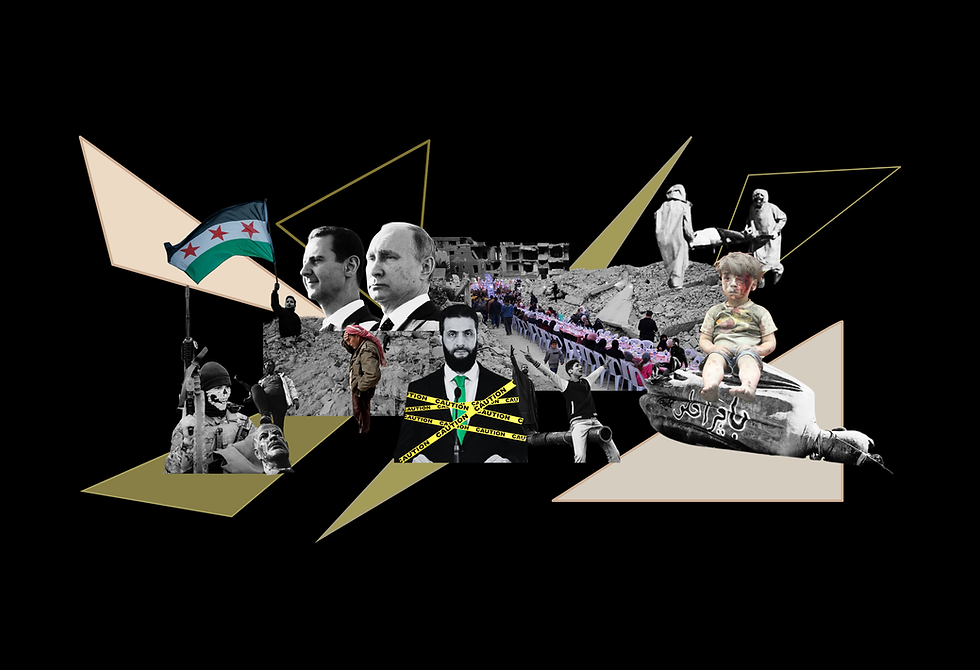
Years of political turmoil and totalitarian politics have led Syria to a crossroads – will the nation seek to move towards liberalization, or revert to sectarian tendencies? After the fall of Bashar al-Assad via coup d’etat, the Hay'at Tahrir al-Sham (HTS) political party assumed interim control. The commentary below provides context for pre-civil war governance, the legacy of the Arab Spring, lessons to heed from it, and the concept of democracy in the Middle East. Finally, a discussion of liberal reforms needed to foster the seed of democracy and the challenges that come with each is included.
Contemporary Political Context
After over 14 years of civil war, 600,000 citizens and combatants dead, and half of the population displaced, cautious optimism seems to dominate international dialogue surrounding the future of Syria after the fall of Bashar al-Assad. The emerging regime, Hay'at Tahrir al-Sham (HTS), maintains that the new governing body aims to respect the rights of minority citizens, aid in constitutional reform, and form an inclusive and representative government. To understand the rise of HTS, however, it is critical to grasp the deterioration of Syria under the Assad regime.
In 1971, after a coup d’état, the Alawite minority Hafez al-Assad established a totalitarian monarchy through the Ba’ath Party. The party gained control of trade unions, civil society, and state institutions, supported internationally and regionally by presenting itself as an anti-imperialist and anti-Israeli regime. Iran and Russia provided financial and military support in exchange for proxy influence in the Middle East, particularly the Levant. The Assad family’s rule was often denoted by exploiting societal divisions, suppressing dissent and free speech, restricting Sunni government participation and political reach, and utilizing violence as an enforcement mechanism. In 2000, after Hafez al-Assad’s death, his son, Bashar al-Assad, assumed power. Initially, Syrians were hopeful for liberalization and reform, yet quickly realized that there would be a continuation of authoritarian rule, one marked by corruption, violence, and brutality.

In 2011, with the sweeping Arab Spring uprisings, the duplicity and cruelty of the Assad regime were further revealed and spread through social media and civil unrest. To combat the protests, Bashar al-Assad engaged in violent crackdowns, such as chemical attacks and prolonged slow conflict, that displaced over 7 million Syrians. Although HTS’ rebel-led offensive catalyzed the physical collapse of the Assad regime in 2024, the cracks had been widening for years. Simultaneously, as the continued civil war eroded Assad’s coalition and military strength, the war in Ukraine captured Russia’s attention, and Iran and Hezbollah focused on Israel. On December 7th, 2024, just 10 days after the start of the offensive, Bashar al-Assad fled to Russia. The following day, Assad’s military unit – the Syrian Arab Army – announced its dissolution, leaving room for HTS and the rebels to claim victory. Although this decisive victory marked the end of a 50-year brutal authoritarian regime, it also signified a significant regional shift. Syria was far from mended, Iran suffered a severe strategic blow in the loss of its proxy power, and a vacuum now left room for a new sphere of influence.
The functioning interim government, led by HTS and Ahmed al-Sharaa, now faces the ruins of a sovereign state, hoping to unite sectarian divisions, reopen diplomatic channels, and restore normalcy in civilian livelihood. Al-Sharaa has signaled that constitutional reform and stability to foster free and fair elections will require an estimated four years of interim work, namely, constitution drafting and institution hardening. The eye of the international community is watching closely. The question then remains: Can Syria stabilize and become one of the first codified and enduring democratic regimes in the Middle East?
In truth, only time will tell. However, if HTS and al-Sharaa can successfully institute liberal democratic processes, economic reform, international cooperation, and cultivate a desire for democracy from within, there remains great potential for a liberal stronghold.
The Legacy of the Arab Spring
To foster an environment in which the seed of democracy can grow, it is necessary to understand modern-day democracy-building attempts in the Middle East and North Africa. In particular, lessons from the Arab Spring ought to be considered carefully, showing not only what motivated citizens to mobilize for democracy and liberalization, but also as a cautionary tale of what went wrong and the lasting consequences of such mistakes.
For a democratic transition, there must be a foundation of trust, protection, and inclusion of civil society influence in the new regime. In the wake of the Arab Spring, Tunisia was one of the few states to adopt institutional liberalization. However, their democracy proved to be volatile, as the process focused primarily on legal and procedural changes, rather than addressing deep-rooted social and economic issues. On paper, the Tunisian democracy codified democratic processes and free elections, but trust in newly developed institutions eroded over time, as they failed to protect human security. The role of civil society in Tunisia was limited to acting as a mediator rather than a full governance partner. Instead of simply coexisting with the government, civil society organizations should play an active role in decision-making; their influence is in the best interest of citizens and their everyday lives. Syria’s transition will benefit from an empowered civil society that helps maintain accountability and represents diverse societal interests.
Another critical lesson from the Arab Spring is the need for bottom-up liberalization from the people, for the people. After the Arab Spring, many countries implemented democracy through political elites, who excluded ordinary citizens from decision-making, weakening legitimacy and reinstating a notion of instability. The only form of liberalization that can take root and endure in Syria is one pushed through grassroots movements designed for citizens' safety, security, and prosperity. Previous, unsuccessful attempts to institute democracy have been viewed by citizens as an imposition of Western ideology, rather than an attempt to increase civil liberties. After years of colonialism, the Arab world, particularly in the Levant, has a sour taste of Western influence and, by extension, most foreign intervention.
Although traditional imperialism ceased decades ago in the Middle East, the enduring consequences are ever-present, highlighted by much of the foreign intervention in post-Arab Spring governance. In several cases, the machinations of foreign governments have resulted in democratic sabotage, fueling the very instability they feared. For instance, interest competition between Egypt, Qatar, and the United Arab Emirates contributed to the fracturing of Libya into rival governments. Ostensibly, foreign powers intervened to protect civilians under the Right to Protect principle, but in reality, it is understood that intervention was linked to geopolitical interests and regional power. As learned from foreign intervention in the Arab Spring, HTS must toe the line between diplomacy, geopolitical exchange, trade, investment, and foreign intervention that may harm stabilization and democracy.
Fragmentation is another aspect of the failures of the Arab Spring that Syria must diverge from. Sectarianism and factions dominate Syrian society as a product of the prolonged civil war and competition between minority religious groups that have historically been persecuted. The Arab Spring showed the world that a fragmented society and a fragile security landscape can destabilize democratic transition. The most prominent example of this failure is the case of Libya. Their inability to integrate factional militias into a state-sanctioned military force eventually led to long-term instability and violent rivalries. Syria already mirrors some of Libya’s faction issues – ethnic and religious fragments around the state are armed and have been acting as their protector for over a decade. In order to consolidate state power and rebuild the security apparatus, and thus trust in the government, the threat of violence and instability must be replaced with a clear chain of command.
Finally, a key lesson of the Arab Spring is that overloading a reform agenda can be counterproductive. Liberalization is a complicated process, requiring the restructuring of government laws and institutions. However, as seen in the case of Yemen post-Arab Spring, attempting to tackle numerous reforms simultaneously, whether it be economic, anti-corruption, or others, can overwhelm a system and oversaturate citizens. Instead, Syria should adopt a phased approach, focusing on realistic benchmarks and gradual improvement, rather than attempting to overhaul everything at once. If al-Sharaa and the HTS coalition can manage to differ from the faults of the Arab Spring, yet cultivate the fervor for significant liberalization, Syria may be able to lead the Middle East to a stable future.
Implementation of Democratic Institutions and Overhauls
All considered, the critical steps outlined above are necessary for Syria to move towards liberalization, stability, and security. First and foremost, the new Syrian regime must make a serious effort at institutional rebuilding, as the Assad regime corroded any true bureaucracy. To foster faith in government-funded organizations, it is necessary to build a secular, civil, and decentralized state, emphasizing equality for all citizens regardless of religion or ethnicity. This may be difficult to navigate as Syrians reconcile with decades of religious and ethnic prejudice. Still, it may be possible for HTS to find a compromise in the construction of the governing and military apparatuses. Beyond just the structural aspect of the government, there needs to be reasonable public confidence and trust in government institutions after decades of corruption, bribery, and cronyism. As seen in the failures of Libya, the inability to develop a central bank, military, defense ministry, stable local-level institutions, and governing bodies fails in post-revolution state-building. To develop those critical institutions, capable bureaucrats must be appointed based on merit and statutes that constrain institutions must be codified via constitutional and legal reform.
Next, the Syrian government must acknowledge and work to alleviate the acute and dire humanitarian crises that plague the general public. Preliminary, conservative estimates note that seven out of ten Syrians need humanitarian aid. The nation ranks fourth in the world for food insecurity; there are over seven million internally displaced people (IDPs), over four million internationally displaced, and more than half of the population lacks stable access to water. Although international aid plays a large role in the rehabilitation of human security, the ruling regime is responsible for the distribution of a lot of monetary aid. Under Bashar al-Assad, Syria redirected large portions of international aid funds to the Assad family and elites by skewing exchange rates, allowing them to divert over 51 cents on the dollar away from the real crises to its reserves. Moreover, with high levels of food insecurity, the Assad regime diverted food and supplies to the military rather than civilians in need. Ahmed al-Sharaa and the interim regime need to aid the acute crisis by equally distributing funds to those in need and transparently reporting to international aid institutions to continue support. For legitimacy and confidence in the current regime to lead Syria to a more prosperous future, human security must be fundamentally supported. Democracy for the people, by the people, can only be mobilized when citizens have the agency to focus on political progress rather than only basic human survival mechanisms.
Democracy for the people, by the people, can only be mobilized when citizens have the agency to focus on political progress rather than only basic human survival mechanisms.
Fiscally, the interim government needs to reform and overhaul the tax system, increase public sector salaries, and restructure ministries for greater efficiency and accountability. One of the most corrupt features of the Assad regime, beyond the diversion of humanitarian funds, was the mismanagement of national funds. It is suggested that Bashar al-Assad redirected nearly three billion dollars meant for the reconstruction of Syrian society to his inner circle and sectors that strengthened the regime's hard power. The corruption and a clear effort to evade international standards for aid resulted in sanctions from many Western nations, which devastated the Syrian economy. Thus, a negative feedback loop was born: diversion of funds perpetuated not only the humanitarian crises in Syria but also the erosion of legitimacy for international organizations and other states, resulting in more sanctions, which in turn resulted in more money allocated to the regime for strength amidst a failing economy. The crippled Syrian economy is limited in access to capital, aid, and foreign investment, so they must work with the international community to lower sanctions and reallocate funds to rebuild the economy from the bottom up. Rehabilitation of a healthy oil industry and rebuilding infrastructure for power plants, water systems, and roads are the first steps. As international sanctions begin to lift, it is critical that Syrians welcome foreign direct investment, invest in energy and agriculture, and stimulate local economies. To attract such investment, it is imperative that HTS establish legal protections for investigators, tighten bureaucratic processes, and reopen and modernize ports to encourage trade.
Diplomatically, al-Sharaa’s government ought to develop more of a working relationship with regional powers, like Saudi Arabia, Turkey, and even Israel, to signal a shift away from dependency and alliance with Iran. Although, unfortunately, strikes between Syria and Israel have continued, al-Sharaa has signaled a desire to open diplomatic channels via indirect talks. Turkey, while advancing on the issue of Kurds at the border, may be a helpful regional ally in terms of energy and the renewal of the sector in Syria. Thus far, Turkey has established procedures for connecting a 400kV line to link Syria and Turkey’s electrical connection by the end of 2025. Moreover, the Turkish energy minister has promised to supply Syria with two billion cubic meters to generate electricity, which has long been unreliable throughout the country. This partnership could set a precedent for regional investment and diplomacy. Past regional support, Syria must reintegrate itself into geopolitics and global institutions. After years of corruption, mismanagement, and non-compliance with international laws, the interim regime must establish transparency in the allocation of funds, buy into institutional constraints, and comply with humanitarian law. In doing so, Syria opens the window for a relief of sanctions, and further foreign direct investment from Western states with the capital and bandwidth to support Syria’s reconstruction. Inflow of capital can stabilize spiraling inflation and reduce the lack of trust in banking institutions.

Politically, it is essential that Syria, after stabilization, establishes free and open elections for citizens. Al-Sharaa has noted that it could take up to four years to reconstruct the constitution and stabilize the nation enough for an election. While the stabilizing capabilities of the interim HTS regime are critical, efforts to reconstruct Syria may be rendered illegitimate if there is not a peaceful transition of power and civil liberties are not established. Bottom-up democracy and inclusive politics directly correlate to improved quality of life and stability. Take, for example, Senegal. A USAID project engaged over six hundred civil society organizations in budget processes and advocacy practices, resulting in large improvements in health services and improved infrastructure. This model is easily applicable to Syria, as infrastructure rebuilding and human security are among the most pressing concerns for citizens. Moreover, the pressure of open elections creates a sense of accountability for those in power. The better quality of life under a given regime often correlates with reelection and maintenance of power. Therefore, political parties vying for power are forced to compete for societal support rather than military coalitions and hard power.
Through a scaffolded approach, the interim Syrian government can take steps in the right direction by reopening the Syrian economy, providing humanitarian support, and engaging in diplomacy, all of which are foundational to liberalization. However, this path is not without its challenges.
Challenges to a Democratic Transition
While there is tentative optimism about Syria’s status due to displayed diplomacy and moderation, former extremism, debilitating divides between Syrian political coalitions, and international interference may prove to be serious roadblocks in the path towards liberalism. The current regime, led by HTS, has made strides towards international diplomacy and claims about restored institutionalism, but has its roots in Islamist ideology. Formed in 2011, the original organization functioned as an al-Qaeda affiliate, carrying out insurgent attacks against the Assad regime. The organization quickly became legitimate by securing funding from the Persian Gulf, collecting taxes in controlled territory, and providing regional security. In 2017, the original organization made a critical political move in separating from al-Qaeda as a competitor jihadist regime, likely as a mechanism to form a legitimate path to political leadership. At present, al-Sharaa and HTS have and will continue to promote higher education, as they did with the provinces they controlled since 2011, particularly for women. Moreover, HTS aims to ideologically separate from al-Qaeda, citing the need for constitutional reform and more relaxed social norms compared to those proposed by extremist groups.
Finally, the looming threat of international intervention poses a great threat to Syria’s future, particularly in the wake of Iraq’s sectarian spiral, and the hope to avoid the same fate. The over-influence of regional powers, like Saudi Arabia, Iran, and Turkey, will threaten to dislodge political stability. As mentioned, it is critical that Syria engages in a degree of regional stability as a method by which to not only prop up a recovering economy but also lessen reliance on Iran and dissolve as a proxy. However, the overreach of neighboring actors also poses a threat to Syrian stability. Although Turkey is well-positioned to aid in the restructuring of domestic industries in Syria, their inherent desire to suppress the conflict with the Kurds on the Syrian border. HTS needs to be accepting of Turkey’s aid, but strong in the defense of Syrian Kurds to avoid the sectarian spiral seen in Iraq. Rather, a unified state, protecting all Syrian citizens regardless of their religious or ethnic minority, is key.
The role of the United States and Russia may also be a defining factor in the success and stabilization of Syria. The US holds significant leverage through not only economic sanctions and diplomacy, but also international signaling and soft power influence. The United States’ recent alleviation of sanctions on Syria, as well as a diplomatic visit with al-Sharaa, have signaled that other Western states may do the same. The symbolic support of the US can open up diplomatic support from the rest of the Western World for Syria, and it is mutually beneficial as a secure ally in the Middle East, which is strategically significant to the US.
Russia, on the other hand, has a substantial role in the endurance of the Assad regime, hand in hand with Iran, complicating the path to democracy. Their influence creates significant obstacles to establishing a governance model free of external control and codified in democratic institutions and ideology. For Iran and Russia, Syria had been a consistent regional opportunity to project power in the Middle East. Increased scrutiny from Western states pushed Syria towards a coalition with the two, acknowledged as an “alliance of convenience”, which included mutual defense and shared intelligence. However, as Russia is preoccupied with the conflict in Ukraine and Iran is dealing with the dissolution of proxy strongholds in Lebanon and Palestine, there is an opportunity to drive Syria away from dependence on the two. It is then up to Western powers to support Syria in a time of need and development, rather than leaving them to revert to support from Russia and Iran. Walking the tightrope between engagement and interference is difficult to gauge, but crucial for societal reconstruction and the liberalization of Syria.
Conclusion
Syria is a nation at a crossroads, where ideas of democracy and liberalization meet the lasting consequences of a nation scarred by war. The deeply fractured social and political fabric, woven through years of devastating conflict and foreign interference, must be sewed together again. The path to establishing a democratic ecosystem in Syria is likely to be fraught with challenges, yet the potential for such a transformation remains achievable, albeit slowly. Constructing widespread liberalization requires the rigorous implementation of comprehensive reforms, including the codification of checks and balances, institutionalization of civil liberties, and the establishment of free, fair, and competitive elections. These measures are critical to fostering a political environment conducive to sustainable and inclusive democracy.
Syria is a nation at a crossroads, where ideas of democracy and liberalization meet the lasting consequences of a nation scarred by war.
Syria’s revolution and regime change carry profound implications for the Middle East, with neighboring nations and global powers keenly invested in its outcome. A shifting Syrian political landscape could redefine regional and geopolitical alignments, which further underscores the interconnected stakes of Syria’s democratic experiment. Neighboring countries and world powers are watching closely, understanding that Syria's political future could reshape the entire regional order. A successful democratic transition in Syria could serve as a beacon for other Arab states, demonstrating that modernization and liberalization can coexist with traditional Arab cultural norms and practices. This transformation would challenge long-held assumptions about authoritarian durability, offering a compelling alternative that empowers citizens without erasing their heritage.
If you enjoyed this work, please consider sharing our content and website, following Mia on the social media platforms listed in her bio, or donating to a non-profit organization linked in the Donate tab.


Comments